

2026 State Of
Value Creation
Benchmark.
How private equity, growth equity, and venture
capital firms are evolving value creation in a leaner,
more complex market.
The Evolution of Value Creation

Core Expectation

Active, Hands-on Support


2026 Benchmark
The 2026 State of Value Creation Benchmark, produced by York IE in partnership with the Magnuson Center of Entrepreneurship at Dartmouth, captures how value creation teams are structured, where they are focused, and how the operating model is evolving across private markets.

Access the Intelligence
Receive the full PDF, including detailed insights and data tables.
- Immediate PDF download
- Key insights into the future of value creation
Why Value Creation Matters Now
Market conditions have fundamentally changed the investor playbook. Longer exit timelines, heightened competition for deals, and increased scrutiny from LPs have raised the bar for post-investment performance.
Portfolio companies are expected to grow efficiently, professionalize faster, and build durable operating foundations, often with fewer resources than in prior cycles.
This shift is reflected directly in the data. Value creation teams are being asked to do more than ever before, spanning GTM, product development, talent, infrastructure, and AI adoption, frequently with limited headcount and tooling.
The Five Most Important Findings
Value creation teams are lean – and under pressure.
Only 17.9% of respondents say they are very confident their team has sufficient resources to meet KPIs, underscoring a structural capacity gap across the industry.

Respondents reporting “high confidence” in current resource levels.
GTM is the dominant lever of enterprise value.
Across nearly every question, GTM and Revenue Operations emerge as the focal point of value creation activity:
- 74.6% spend the most time on GTM
- 67.2% rank pipeline generation as their top priority
- 44.8% say GTM drove the most enterprise value in the last 24 months
Execution challenges are moving upstream into product and infrastructure.
As GTM systems mature, friction increasingly surfaces in product delivery and technical foundations. Nearly 30% cite product delivery and infrastructure as top challenges.
Top Operational Bottlenecks
AI is the most important opportunity — and the largest gap.
The disparity between AI ambition and execution is stark. While viewed as the top driver of future value, over a third of respondents identify it as their most underserved operational area today.
35.8%
say AI and automation are currently the most underserved areas.
believe Generative AI will have the "greatest impact" on future value creation.
Leadership and talent remain critical execution multipliers.
Leadership capability consistently emerges as both a constraint and a value driver, reinforcing that execution increasingly hinges on people — not just strategy.

C-Suite Assessment
Top priority for Year 1

Talent Augmentation
Fractional leadership support
Voice of Our Partners
Leaders across the industry share more on the current
and future state of value creation.
“This benchmark offers a rare, data-backed look at how value creation is actually practiced today. It highlights both the growing complexity of the role and the opportunity for firms to rethink how value creation teams are structured, resourced, and enabled going forward.“

Jamie Coughlin
Founder and Executive Director of the Magnuson Center for Entrepreneurship at Dartmouth“Leading firms are standardizing frameworks, metrics, and expectations across the portfolio, which creates faster diagnosis, clearer prioritization, and more consistent outcomes. Value creation teams are acting less like consultants and more like system builders.“

Roylee Sanchez
SVP, Value Creation, Blue Star Innovation Partners“We’re seeing a clear transition underway. The firms that outperform will be those that move beyond one-off interventions and build repeatable, system-driven approaches to value creation – aligning GTM, product execution, talent, and technology across the portfolio.“

Joe Raczka
Managing Partner at York IE“Value creation is table stakes. It is an expectation versus necessarily a differentiator. Portfolio value creation teams now need to prove their worth post investment by tangibly and concretely creating incremental equity value.“

David Badler
Head of Portfolio Value Creation, Susquehanna Growth Equity“As GTM execution improves and becomes more standardized, product and technical foundations are becoming increasingly exposed as a limiting factor. Product vision is not what separates those who ship from those who stall – just like any other aspect of a growing software business, it’s operational discipline that becomes essential at a certain stage.“

Lauren Janek
Principal, Value Creation, Five Elms Capital“Value creation is no longer about ad-hoc support or high-level strategy alone. What this data shows is that firms know where they need to go, but many lack the operating models, technical foundations, and capacity to get there. The next phase of value creation will be defined by leverage and execution, not intent.“

Mike Veilleux
Managing Director, Operating Platform at York IEThe Industry’s New Operating Model

Growth at all costs
Historically, firms relied on high-touch, bespoke engagement to support portfolio companies.

The Efficiency Pivot
While this approach remains prevalent – 89.6% still rely primarily on direct engagement – it is becoming increasingly difficult to scale as portfolios grow and mandates expand.

Algorithmic Operations
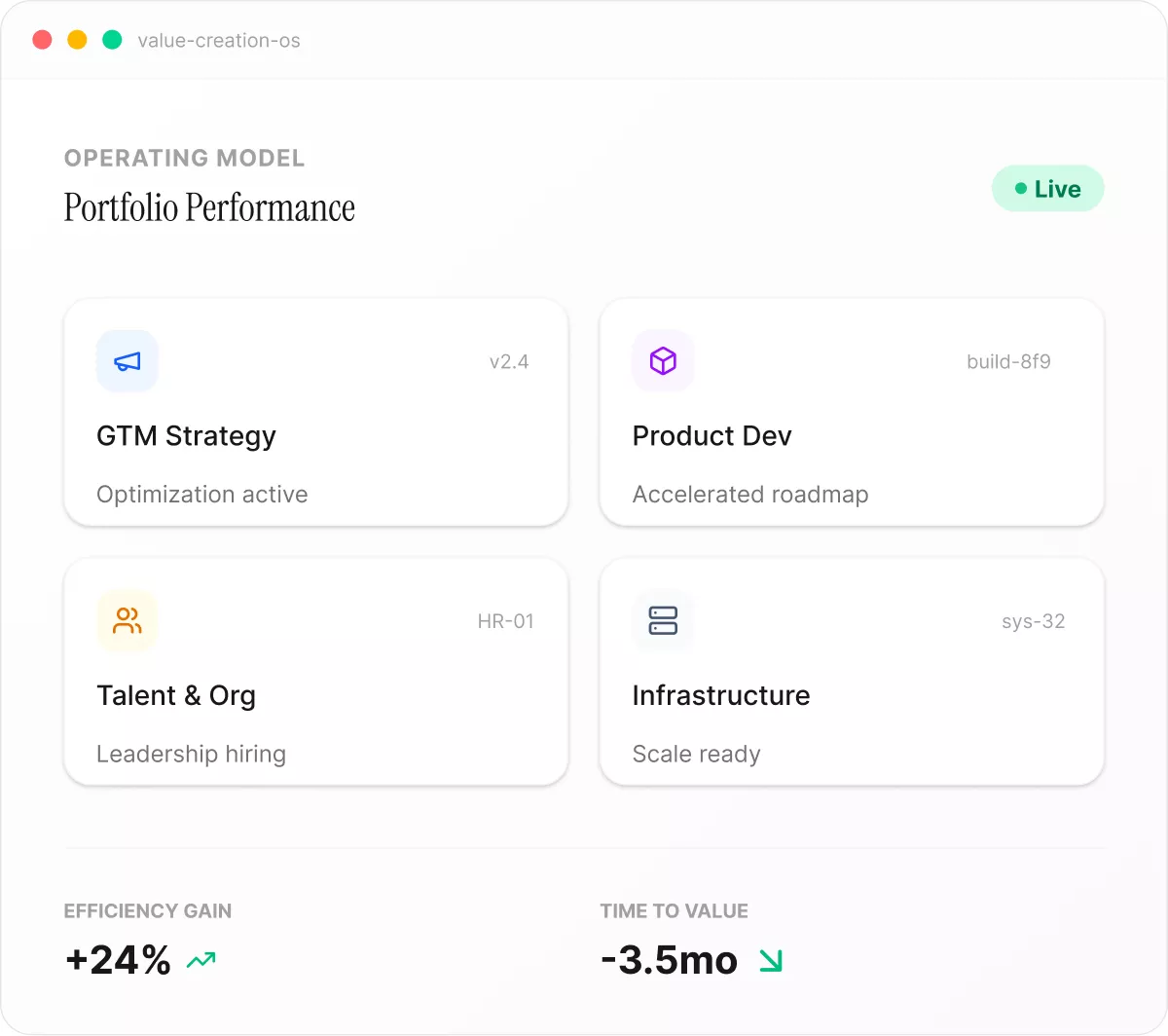
The next generation of value creation will be defined by more systematized approaches: standardized playbooks, integrated operating frameworks, AI-enabled workflows, and real-time portfolio insights.
Download the Full 2026 State of
Value Creation Benchmark
Get access to the full report, including detailed data, analysis, and insights
on how value creation is evolving across private markets.