
There’s a tension playing out inside almost every growth-stage company right now, and it usually surfaces in the same leadership meeting.
Someone – maybe a board member, maybe a new hire – looks at what AI can do and says: we should rebuild this from scratch, the right way.
And someone else – usually whoever runs the team that’s currently delivering – says: we can’t stop the engine mid-flight.
Both people are right. That’s what makes it hard.
We brought this question to our recent State of the Industry discussion on value creation, where Blake Tiemeyer of General Atlantic and Amy Kramer at Level Equity broke down how they’re thinking about it.
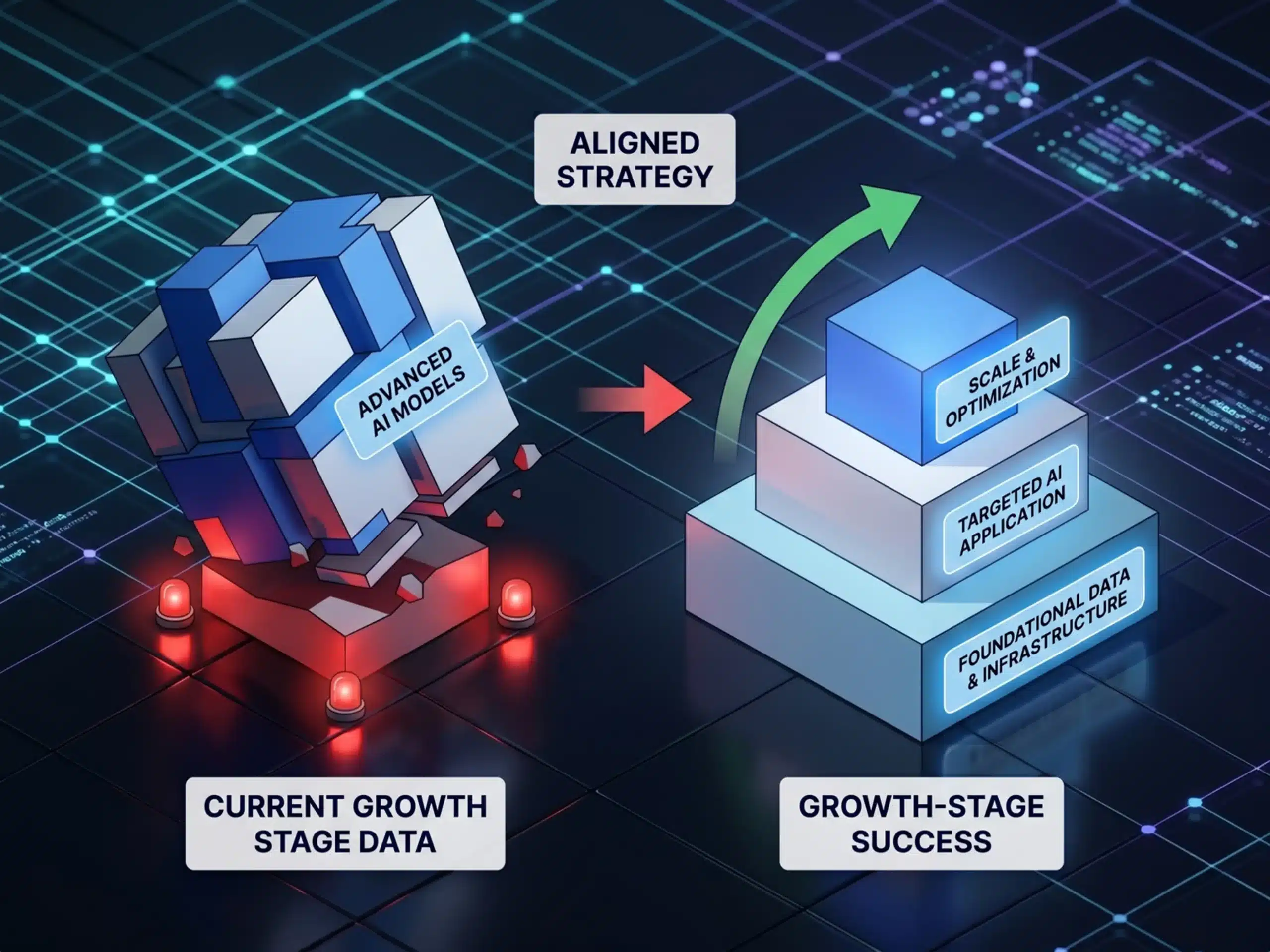
The mistake most companies make isn’t being too aggressive or too cautious with AI.
It’s applying the wrong strategy for where they are. The companies getting this right have stopped asking “how do we use AI?” and started asking “what does our business actually need AI to do right now?”
AI Positioning Mirrors Strategic Positioning
During the webinar, Blake walked through a study of 250 portfolio companies across stages, and the pattern was striking: slower-growing companies almost universally focused AI investment on protecting their existing base – improving retention, reducing churn, making customer success more efficient.
Hyper-growers, on the other hand, were deploying AI aggressively in demand gen, top-of-funnel, and pipeline creation.
This isn’t a coincidence.
It mirrors what we know about strategic positioning more broadly. When you’re in a defend-and-extend posture, you’re trying to maximize the value of what you’ve already built.
AI helps you do more with what you have – better support, faster response times, smarter renewal triggers. When you’re in an aggressive growth posture, AI is fuel. It lets you scale outbound, personalize at volume, and test positioning faster than any human team could.
The trap is when companies get these backwards: a slower-growing company tries to use AI to blow up what’s working, or a hyper-grower gets so cautious about “doing it right” that they lose the speed advantage AI was supposed to give them.
Healthy Growth Companies Can’t Cut Back
For companies that are in a healthy, compounding growth phase, AI creates a specific kind of pressure that’s easy to get wrong.
Customers’ expectations are rising in real time. What your product could do last year isn’t the bar anymore – the bar is what the best AI-assisted products in your category can do today. That means your engineering team has to keep building, and your GTM team has to keep executing. There’s no room to hit pause and “figure out AI.”
The right approach here isn’t transformation – it’s augmentation. You’re layering AI into existing workflows: copilots for your support team, AI-assisted outreach for your SDRs, automated QA for your engineering pipeline.
The goal is capacity and speed without disrupting what’s working. These companies should be asking: where are our teams spending time on work that AI can do just as well? That’s where you start.
Pulling back on engineering headcount or GTM resources to “invest in AI” usually backfires at this stage. You don’t have the runway to absorb the dip, and your customers won’t wait.
Transformation-Stage Companies Have More Freedom
The calculus changes completely when a company is in a true transformation moment – launching a new business line, entering a new market, or rebuilding something that’s broken.
At that stage, you have something valuable: a blank canvas. And AI lets you fill it very differently than you would have two or three years ago.
Amy gave a compelling example during the webinar that stuck with me. She’s seen companies launch an entire SDR function without hiring a single SDR first. They use AI-assisted outreach, intent data tools, and automated sequencing to run a real pipeline motion – and then hire humans into the roles where human judgment actually matters, once they know what those roles look like.
That would have been impossible to do responsibly a few years ago.
Now it’s a legitimate strategy. The point isn’t that AI replaces people – it’s that transformation-stage companies can design their operating model around AI from the beginning, rather than bolting it on later.
That’s a meaningful competitive advantage, and most companies aren’t taking full advantage of it.
You Have to Slow Down Before You Can Speed Up
Here’s the paradox that comes up every time I talk to a portfolio company CTO or CRO about AI adoption: the teams that get there fastest are usually the ones that slowed down first.
Forcing adoption doesn’t work. Mandating that your team use a new AI tool without giving them time to actually understand it produces surface-level compliance and real resistance underneath. What does work – and what we’ve seen work consistently – is creating space for teams to learn before they’re expected to perform.
That looks different depending on the team. For some, it’s structured hackathons where people can experiment without the pressure of shipping. For others, it’s identifying internal champions — the people who are genuinely excited and letting them evangelize peer-to-peer, which is far more credible than top-down mandates.
As Blake mentions during our conversation, gamification can help in the right contexts, especially for sales teams who respond to competition. And storytelling matters more than most leaders think: sharing concrete examples of what AI actually did for a specific person on a specific deal, not generic ROI stats, is what shifts mindsets.
The underlying principle is that AI adoption is a learning process, not an installation process. It takes time, it takes repetition, and it takes leadership that’s willing to protect the learning curve even when there’s pressure to show results.
The New Operating Rhythm
Whether you’re augmenting or transforming, AI is compressing timelines across the board.
Product ships faster. A feature that would have taken a quarter takes weeks. Positioning experiments that used to take a full campaign cycle can be tested in days. This is genuinely exciting…and it’s also a leadership problem that most companies haven’t solved yet.
Your operating cadences were designed for a different pace. The monthly leadership review, the quarterly OKR check-in, the annual planning process – these rhythms made sense when the business moved at the speed they were built for.
If your product team is now shipping 3x faster, but your leadership team is still reviewing strategy quarterly, you have a disconnect. Decisions are being made at the team level that should be surfaced and aligned on much sooner.
This is one of the more underrated challenges of the AI era for growth-stage companies: it’s not just about what you build or how you deploy, it’s about whether your leadership operating system can keep up with the pace the tools now enable. Most can’t – yet.
The Bottom Line
There’s no single AI strategy that works for every company.
What works is understanding your stage, your constraints, and your growth posture – and making decisions that match your reality, not someone else’s.
That’s easy to say and genuinely hard to execute. The companies getting it right are the ones that have leadership willing to be honest about where they actually are, and advisors who have seen enough patterns to help them navigate the specific terrain they’re on.
Blake and Amy went deep on exactly this during our value creation webinar, including specific frameworks they’re using to advise portfolio companies at every stage.
If you want to hear the full conversation, watch the webinar here.