

Bruce MacVarish, AI innovation and GTM expert, has spent his career building and pricing enterprise software products. This is the second in a series of guest posts from Bruce on GTM strategy in the age of AI. Click here to read Bruce’s first post.
In 2012, Jeff Bezos was asked the question every executive expects: what will change in your industry over the next ten years? He gave a different answer than the one he was asked for.
The more interesting question, he said, was what won’t change — because that’s what you can safely build a strategy around. His own answer was almost embarrassingly plain: customers will always want lower prices, faster delivery, and vast selection. No one was going to write him a letter in ten years complaining that Amazon had become too cheap or arrived too quickly.
That plainness was the point. A strategy built on a trend has a shelf life measured against the trend itself. A strategy built on an invariant compounds for as long as the invariant holds — which, for a basic human or economic desire, is usually longer than any company’s planning horizon. The harder problem Bezos left unsolved is a practical one: how do you actually tell an invariant from a trend wearing an invariant’s clothes? Not every “this will always matter” claim in a strategy deck deserves the confidence it’s given. Some of what looks permanent is really just today’s technology cycle, described in language general enough to sound eternal.
That distinction is worth making explicit, because it’s where most strategic overconfidence hides. Not all durable-sounding claims are equally durable. Some are true regardless of what happens in the world. Others are true only because of how markets and economies currently work, and would need re-deriving if those conditions shifted. A third kind is really a bet on a temporary gap — a real pattern, but one with a shelf life, dressed up as a law of nature. Conflating these three is how strategies that felt bulletproof in the boardroom turn out, in hindsight, to have been arguments about timing rather than truth.
This confusion rarely announces itself. It shows up quietly, in the language a team uses to describe its own advantage. Founders and executives alike reach for the vocabulary of permanence — “this will always matter,” “there’s no going back” — to describe advantages that are, on closer inspection, contingent on today’s regulatory posture, today’s cost of compute, or today’s gap between what a large incumbent has shipped and what it hasn’t gotten around to yet. None of that makes the advantage worthless. It makes it perishable, and worth treating as such rather than mistaken for bedrock.
Three Tiers of “Won’t Change”
Extending Bezos’s insight into something usable requires separating what people want, from what markets allow, from what happens to be true right now. Three tiers do the job.
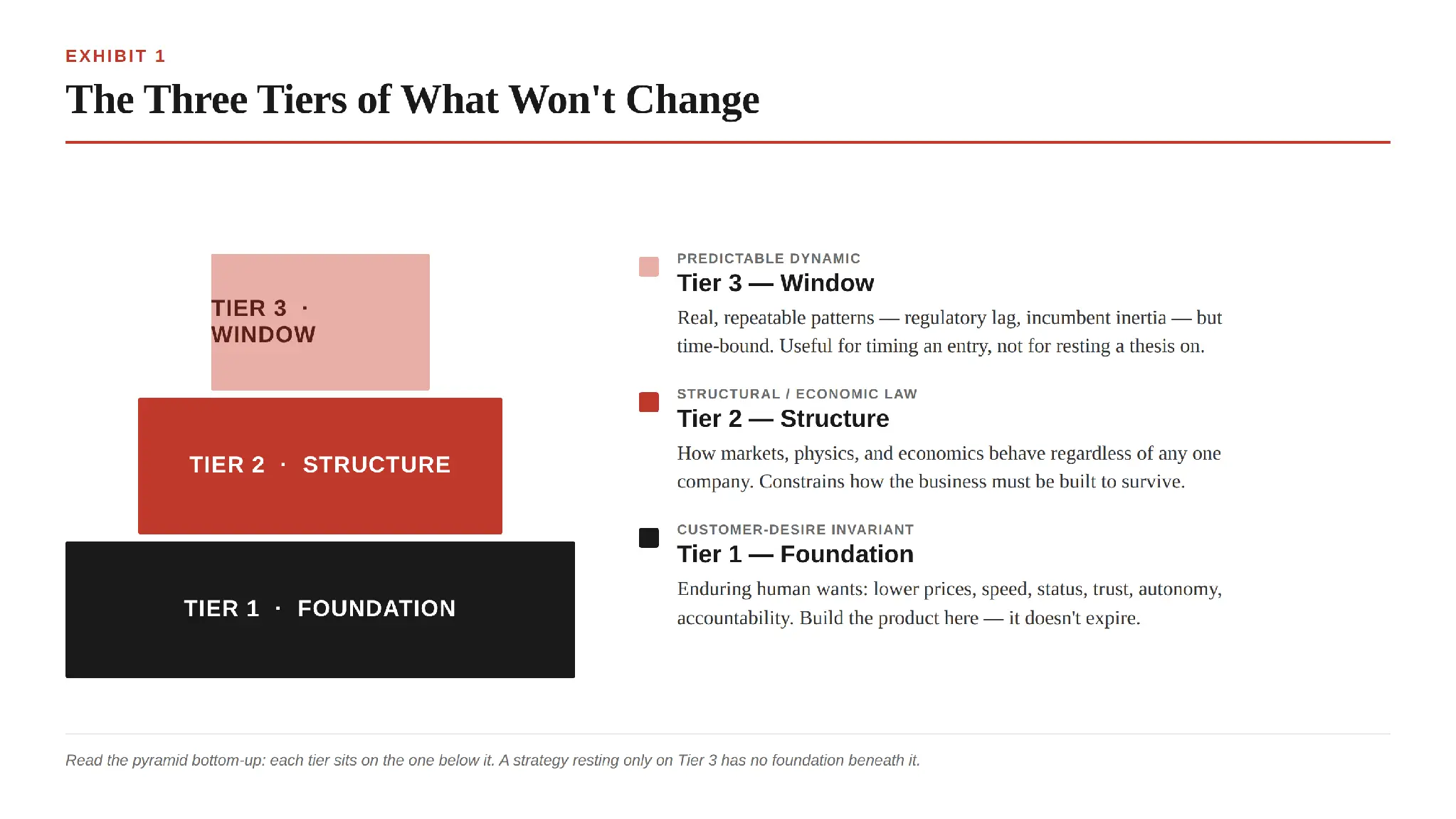
Tier 1: Foundation – Customer-desire invariants
These are wants that predate the specific technology serving them and will outlast it — Bezos’s lower prices and faster delivery, but also the desire for status, trust, belonging, autonomy, accountability when something goes wrong, and time saved through delegation. These don’t change because they’re rooted in what people are, not in what’s currently possible. A product built directly on one of these is playing a game that doesn’t end when the technology matures; it only gets easier to serve the same desire better.
Tier 2: Structure – Structural and economic laws
These are features of how markets, physics, and economics behave, independent of any one company. Coordination costs create a persistent role for intermediaries. Data that’s genuinely hard to aggregate stays a moat longer than data that isn’t. Network effects compound once they start. Someone bears liability when automated systems fail, which keeps insurance and oversight markets alive even as the underlying task gets automated. These aren’t desires — they’re constraints. They tell you less about what to build and more about how anything you build has to be built in order to survive.
Tier 3: Window – Predictable dynamics
These are patterns that repeat reliably enough to bet on, but that are time-bound rather than permanent. Regulation lags innovation — until, eventually, it doesn’t. Incumbents underinvest in disrupting their own most profitable businesses — until a threat becomes existential enough that they finally do. These dynamics are real and genuinely useful for timing an entry. They are not, however, permanent features of the world. A strategy that depends entirely on a Tier 3 dynamic is really a strategy about when, mislabeled as a strategy about what.
The three tiers aren’t equally weighted, and that’s the point of separating them. Tier 1 is where the enduring value of a business should live. Tier 2 is what constrains shape how that value gets delivered and defended over time. Tier 3 is where you find your window and is useful for deciding when to move.
A strategy that depends entirely on a Tier 3 dynamic is really a strategy about “when”, mislabeled as a strategy about “what”.
— THE THREE-TIER FRAMEWORK
Why the Distinction Matters More as Technology Accelerates
Bezos’s original framing came at a moment when e-commerce infrastructure was maturing but hardly finished. The generative AI moment poses the same question with much higher stakes, because AI compresses the distance between “this is a genuine advantage” and “this is now free.” Techniques, model capabilities, and even entire product categories that felt defensible eighteen months ago have since become table stakes, absorbed into a platform’s default feature set or a competitor’s weekend project.
Consider a hypothetical AI security startup pitching faster detection of a novel attack pattern. That capability is real, valuable, and worth building — but it is a Tier 3 claim: a timing bet on a gap that exists today because the attack pattern is new and defenses haven’t caught up. It will not still be a differentiator in three years, because either the pattern will be well understood and defended against industry-wide, or a platform provider will have absorbed detection into its own default offering. The startups in this position that endure are the ones using the detection wedge to build something else underneath it — a Tier 1 foundation of trust and accountability (customers rely on this company specifically when something goes wrong) and a Tier 2 moat of proprietary incident data that’s genuinely hard for a competitor to replicate. The detection speed opens the door. It is never, by itself, the reason the company is still standing once the door has been open for a while.
This is not an argument against speed or against exploiting real, current advantages. Tier 3 opportunities are legitimate and often lucrative — first movers into a regulatory gray zone, or into a market an incumbent is too slow to defend, can build real businesses in the window before the gap closes. The discipline is knowing that’s what you’re doing, and building the Tier 1 and Tier 2 foundations underneath the window before it shuts, rather than mistaking the window itself for the foundation.
A second example, outside security
The same pattern shows up well beyond security. A wave of generative-AI writing and design tools built their early pitch almost entirely on a Tier 3 claim: producing content faster and cheaper than a human alone could. That gap was real, and it was large enough, for a while, to support real revenue and real funding rounds. It was also always going to close, because the underlying model capability was never proprietary to any single application layer — it was rented from a small number of foundation-model providers who had every incentive to fold basic generation into their own default products. The tools that are still standing now are, almost without exception, the ones that used that early speed advantage to build something else: a Tier 1 foundation in a durable desire — trust in the brand voice produced, or status conferred by using a particular creative tool — or a Tier 2 foundation in proprietary workflow data that a generic model provider cannot easily see or replicate. The ones that didn’t make that shift look, in hindsight, like thin wrappers around someone else’s temporary gap.
Five Principles for Using the Framework
- Anchor the value proposition in Tier 1, not Tier 3. Before funding or committing to a strategy, ask what enduring desire it serves once the current technological moment passes. If the honest answer is “it’s faster than the old way of doing X,” that’s a real but temporary advantage — every faster way eventually gets a faster way built on top of it. If the answer is “it gives people more control, more trust, more status, or more of their time back,” that’s a foundation that survives the next platform shift.
- Let Tier 2 dictate architecture, not just messaging. Structural laws don’t tell you what to sell, but they tell you how to build so the business doesn’t erode from underneath. If your data isn’t genuinely hard to replicate, don’t describe it as a moat in the strategy memo — describe what you’re going to do to make it harder to replicate. If your margins scale with compute cost, model that explicitly.
- Treat Tier 3 as a clock, not a wall. A regulatory gap, an incumbent’s slow reaction, or a temporarily favorable underwriting regime are real advantages, but each comes with an expiration date that a competent competitor or regulator will eventually enforce. Name the clock explicitly in the strategy document — “we have an estimated 18 to 24 months before this dynamic resolves” — rather than leaving it implicit.
- Separate the durable claim from the strategy for realizing it. “Businesses need access to capital” is a Tier 1 invariant. “We win because we can underwrite faster than incumbents right now” is a Tier 2 or Tier 3 claim riding on top of it. Both can be true at once, but they should be evaluated, and stress-tested, separately — the invariant almost never needs defending, while the mechanism riding on it always does.
- Make the bear case a formal step, not an afterthought. For every Tier 2 or Tier 3 claim in a strategy, someone in the room should be assigned to argue the version where a well-resourced competitor replicates it, a platform absorbs it as a feature, or the regulatory and economic conditions shift. This is uncomfortable and easy to skip under deadline pressure — which is exactly why it needs to be a scheduled step in the planning process rather than something that happens informally if someone gets around to it.
Practical Recommendations for Leadership Teams
- Run every major strategy document through a tiered audit before it’s finalized. For each core claim, ask whether it’s true because of what people fundamentally want, because of how markets and physics work, or because of a gap that currently exists but won’t always. Mark each claim accordingly in the document itself, so the tiering is visible to everyone reading it — not just implicit in the author’s head.
- Track the allocation over time, not just at a single point. A useful diagnostic for a leadership team is the rough percentage of the company’s stated value proposition that rests on each tier — and whether that allocation is shifting. A business that started sixty percent Tier 1 and has drifted to sixty percent Tier 3 as competition intensified is quietly re-betting itself on timing rather than durability, often without anyone deciding to make that trade explicitly.
- Ask “who replicates this, and how fast” as a standing question, not a one-time gate. Moats erode continuously, not just at the funding round when someone happens to ask about them. Build the question into quarterly strategy reviews, not just the initial pitch or annual planning cycle.
- When entering on a Tier 3 window, build the Tier 1 and Tier 2 foundation concurrently, not afterward. The businesses that survive a closing regulatory or timing gap are the ones that used the window to build durable trust, proprietary data, or genuine switching costs — not the ones that used it purely to grow as fast as possible while the gap stayed open.
- Revisit the classification; don’t just perform it once. What counts as Tier 2 or Tier 3 can shift over time — a regulatory gap can calcify into a permanent licensing structure; a data advantage that once looked durable can become commoditized once an industry standard emerges. Build a recurring habit of re-checking old claims against new conditions, rather than treating the original tiering as a one-time exercise done at launch.
The Discipline of Sounding Boring
Bezos’s insight endures not because “customers want it cheaper and faster” is a clever observation, but because it was deliberately, almost aggressively unoriginal. That’s the discipline worth carrying forward as AI reshapes one industry after another: strategy built to last should sound a little boring. If a claim in your next planning document only feels true because of what’s happening in the market right now, it probably belongs in Tier 3 — useful, timely, and worth acting on, but not something to build a decade-long bet around.
The claims worth building a company on are the ones that would have sounded just as true, and just as unremarkable, a decade ago — and will sound just as unremarkable a decade from now. The technology underneath any given strategy will keep changing, often faster than any plan can account for. The desires it’s really in service of, and the structural laws it has to survive within, change far more slowly, if at all. Sorting the two apart, deliberately and on paper, is the closest thing to a durable edge a strategy team can give itself in a market that won’t hold still.
Bruce MacVarish served as Senior Director of Product Management and Strategy for Customer Success Services and Cloud Infrastructure at Oracle. He advises startups and enterprise leaders on AI Product Strategy, AI Security and break-out market strategies.