Tailwinds of 2020

I called out to Twitter for some positivity as we turn the page on a unique, challenging, and resolve testing 2020. As always, the social media platform and its users responded with stories, anecdotes, inspiration, perspectives, and entrepreneurial spirit. We all know the headwinds the pandemic brought, but what about the tailwinds? There have to be some, right?

Throughout the year, I’ve talked a lot about the headwinds and tailwinds we’ve faced in our startups, businesses, careers, families, economy, health (mental and physical), and society in general. We are always facing macro and micro crises, and it’s how we respond that makes all the difference. As we move into 2021, we wanted to share the unedited replies on the York IE blog.

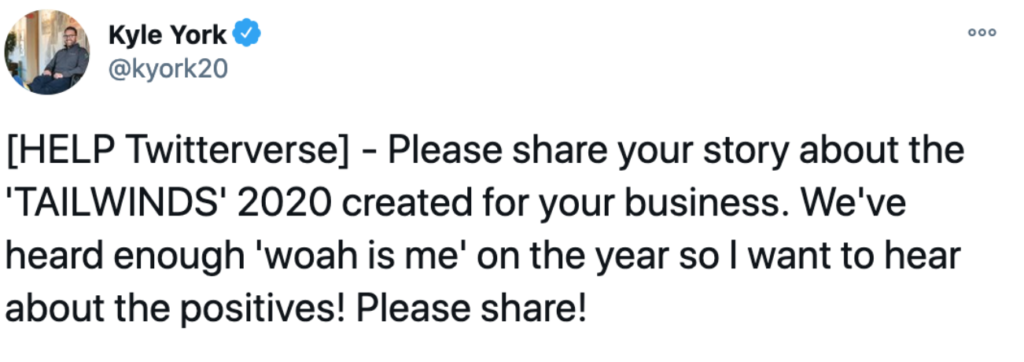
The request: 
The replies:

“The crazy, tumultuous upheaval that it brought to tech (aka “Digital Transformation”) has execs wondering now how they can keep up the pace. We enable architectures that can change in real-time, so that’s gold for us.” via @tkunze of @glasnostic

“Kyle, I love the positivity! Once work-from-home accelerated, and spending slowed early in the year our team got creative and released a free version of Defendify. We had thousands of signups and looking back it feels good to know we helped those businesses get better protected.” via @RobSimopoulos of @Defendify

“A huge part of our revenue comes from processing collections at doctor’s offices. When collections dropped because things like elective procedures and in-person visits tanked and we saw a 3,400% increase in daily telehealth visits across our network we seized that opportunity and built, launched, and brought to market a cloud-based telehealth solution to enable providers to continue to provide needed, regular care in lieu of in-person visits.” via @ItsTomSnow of @athenahealth

“Taking on a new adventure in joining @yorkgrowth, launching the startup services and helping so many startups double down on drumbeat marketing.” via @BostonKate of @yorkgrowth

“Although work from home has a lot of pitfalls, it has also meant a crazy amount of focus and productivity allowing us to launch a new company from cradle to paying customers in 6m

@finmarkhq.” via @ramiessaid of @finmarkhq

“Launched a paid family and medical leave product as a private alternative to state funded programs. Interest in the product spiked when employees had to stay home to take care of loved ones or themselves.” via @GVanderbeken of @TheHartford

“We learned to rely on each other even more than we did before the quarantine. Transitioning to a 100% virtual company made us more efficient and effective. Our productivity skyrocketed as did our CSAT!” via @stevebainz of @Forcivity

“Challenges in our supply chain forced entry into new services & product categories, created differentiation, new and improved vendor relations and overall a path to improve our way through the stress test of COVID.” via @PTsAreHeros of @PT__United

“A number of positives in the past 4 months Kyle! 1. we launched our iOS and Android apps and data platform and had/have great traction with little mrktng. 2. Raised >$270k preseed from a starting start. 3. Wonderful motivated team & advisors. Nicely setup for 2021!” via @ravroberts of @PharmaSentinel

My tailwind:

“It may sound crazy but this was the best year of my working life from a happiness perspective. Everything came together for York IE and our team — and most importantly I was able to spend more time with my family. Work travel has its place but man I loved not having any of it. ❤️” @kyork20

Instead of talking about the obvious momentum in enterprise SaaS, cybersecurity, digital transformation, alternative investments, rolling funds, remote work et al., my biggest tailwind is more personal, and I’m blessed. We wish you all good health and happiness. Carry on, and Happy New Year!


The Startup Board of Advisors

In early-stage startups, especially those raising capital, it’s important to exude confidence to the market. There are so many ways to do this well — from actual traction and results, a strong founding team, an innovative product that’s been incubated in stealth, or a strong market opportunity. In the end, the most successful startups out-execute everyone else in their space and from day one practice drumbeat marketing to tell their story with confidence to the world.
When looking at initially working with a startup, potential investors and early hires, customers, and partners look at key indicators for success —  vision, market opportunity, product capability and roadmap, GTM strategy, customer and revenue traction, and financial viability from a look back (P&L performance) and go-forward perspective (3-5 year long-term model). No one wants to work with an immature company that may not be around in a year or two — unless they can display a hardened foundation with immense upside. An upside so grand that people will bet their career on them as we’re all the CEO of our own career.

What Can a Startup Board of Advisors Bring to the Team?

One way to strengthen a core story and bring expertise to a team is through a startup’s board of advisors. Typically, there are 3-5 individuals sought out, compensated by equity in the form of stock options on a vesting schedule, I’ve seen a wide range here .1% to 1.5% or even higher if more actively involved and/or bringing real resources. The typical is .25%-1% at the earliest stages. Usually a 2-3 year vest.
The issue is, advisors are certainly not all created equal. They can be a good or bad use of time and the option pool.
A Startup’s Board of Advisors falls into three categories:

  1. 90% add no value, are a pic on a slide/website, MIA, reactive
  2. 5% add negative value, distract, don’t get your business, need to be chased
  3. 5% add a TON of value, are always available, bring expertise, connect network, proactive

I’d also add that these things, like the usefulness of a board of directors (beyond governance), or alignment of an executive team, are only as good as the CEO and founder’s ability to leverage these folks. That’s the common theme of success and leadership. MOST startup advisors don’t KNOW how to be valuable.
Leverage the value that your advisors bring. Don’t wait to ask for help or for a scheduled call or board meeting and use them as strength, ask for advice and resources when needed. You’re paying them to help, so use them.

What We Believe

At York IE we’ve created advisory/consulting services to support our portfolio of investments and work directly with many more. We also have investment partners and advisors who introduce and play matchmaker directly with our startups where they can make an impact. Please reach out if we can help. We’re part of #3 above → the proactive and value-multiplier 5%.
It’s important to choose wisely in aligning this talent for many reasons. They represent you but can be expensive and deadweight so they need to deliver a strong ROI. Choose wisely and make it count! 🧠

Market Pulse Data/AI: AI Enhancing Customer Service 

In today’s Market Pulse, powered by Fuel, we take a look at our Data/AI watchlist and discuss the roles Artificial Intelligence can play in your customer service. By applying machine learning to our customer service departments we can actually enhance rather than replace. Artificial intelligence (AI) should not be seen as an alternative to customer service, but rather, an aid to help employees serve their customers more efficiently and effectively. With the help of AI-powered solutions, companies gain deeper insights into their customers while also learning how to better address their needs more proactively.

  • Watchlist company Coveo recently published a blog listing four use cases where AI can be used to enhance customer service

Boston Based Indico Announces $22M Round 

This week, Indico, a Boston based Enterprise AI company, specializing in Robotic Process Automation (RPA) announced a $22M Series B round. The news comes almost three years after the company announced their $4M Series A round and brings their total capital raised to $26M since Indico opened their doors in 2013. With this latest round, led by Jump Capital and Sandbox Ventures, Indico looks to double their headcount and fill leadership roles within their sales and marketing divisions. 

Why This Transaction? 

The York IE team chose this as our transaction of the week to highlight advancements being made in the Robotic Process Automation (RPA) market as well as the different approaches to tackling unstructured content. By implementing automated classification, organizations gain easier access to corporate knowledge and increased findability over their documents. As organizations continue to look within for workflows that can be automated, RPA’s offer a scalable solution to automate back and middle office tasks. With the help of RPA’s, companies can analyze unstructured data such as social media posts, videos, photos, etc. to gain deeper insights on their data and customers. Many companies looking to trim operational costs during the COVID-19 pandemic have turned to the digitization of their workflows. However, digitization has not had a profound effect on unstructured content, which on average, makes up roughly 80% of the company’s data. Indico’s approach to RPA parses data using Artificial Intelligence to deploy custom models capable of analyzing industry-specific data. Indico’s solution makes building and deploying business-specific models easy to do and requires little data science experience from its users. As automation and digitization continue to find a home within every industry, more and more solutions are taking a low-code/no-code approach to be as scalable and intuitive as possible. Companies in every industry can now deploy a full stack of automation tools to digitize their workflows without the assistance of their IT department. 

Cost Saving Automation

Traditionally, RPA’s were predominantly deployed by large enterprises that had the resources and personnel to operate these new systems. Now, as automation solutions become more accessible, SMB’s have begun deploying their own solutions to avoid being outmaneuvered by competitors. Companies are still reluctant to make the switch to automation face potentially higher opportunity costs than the price of the solution itself. With this in mind, it is important for all organizations to reevaluate their workflows and identify opportunities for automation; by freeing up man-hours, companies can redirect their employees to projects that require a human touch.

Blustream’s New Approach to Customer Experience

According to Temkin Group, investing in customer experience initiatives can double your revenue in three years. Not to mention that more than 86 percent of buyers are willing to pay more for a great customer experience. 
With this kind of data, you would think that every brand and company wanting to make money would be investing in customer experience. While unfortunately, this is not the case, Worcester-based startup Blustream is making it happen for physical goods companies. I’m excited to share that I’ve joined the Blustream Board of Directors to help drive strategy and shape the future of the company. 

Opportunities for Blustream

Blustream is a SaaS-based product experience platform helping physical goods companies build after-sale connections between their products and end-users. With its technology, Blustream connects brands to their consumers in a way that’s never been done before — through the products themselves. Through product lifecycle data, Blustream helps to build ongoing connections between products and end-users and delivers personalized recommendations via alerts, education, and purchase recommendations. By creating a live connection via the product, Blustream helps physical goods companies to develop strong after-sale customer engagement and experience strategies, so these brands can see the ROI that CX can bring. 
My family and I just got a new puppy, and I think about the value that Blustream could bring in the early days of us learning more about our new pet. With Blustream’s technology and a few initial data points from us (like size, location, and age), Blustream could alert us that a storm is coming and our new puppy may be scared, prompting me to read more about thunder vests for puppies. Talk about next-gen! 
While the concept is clear — what’s truly innovative is that Blustream is taking on a concept that was once said to be impossible. Brands have struggled to make these connections due to a lack of resources, money, and technology availability. How could a company make these high-end things “smart things”, without a technology partner offering a Platform-as-a-Service (PaaS) for them to integrate with? Blustream’s Product Experience Platform truly makes it easy for companies who are passionate about their own products to develop and deliver on CX. 
That’s what gets me so excited about the company and the opportunities the team has to disrupt the market. The Blustream operating talent and Board of Directors, including Ken Rapp, Tom Folliard, Bhaskar Panigrahi, and Robert Bean, have incredible experiences disrupting markets and building great companies. I’m looking forward to working with the collective team to provide new opportunities for brands to increase CX to ultimately drive revenue. 

York IE and Blustream

Blustream recently announced a three million dollar funding round, led by York IE. We have been working with Blustream for more than a year, and in that time I’ve seen incredible growth, passion, and drive from Ken and the Blustream team. Check out our Blustream Investment Rationale to learn more about why we are so excited about the opportunities that Blustream can bring to the table. 
The future is bright for physical goods companies who want to work with Blustream to create great customer experiences!

Bryan Goodwin Joins York IE As An Investment Partner and Advisor

York IE, a vertically integrated investment firm, announced today that Bryan Goodwin is now an investment partner and advisor for B2B SaaS and marketplace businesses within the York IE portfolio.

A seasoned early-stage startup executive, Goodwin brings more than 15 years of experience in sales, business development, and revenue generation. He has worked at several household brands, helping these companies to establish a clear vision to ultimately deliver enterprise value. Advising and investing in more than 25 startups in the past five years, Goodwin’s expertise will translate to clear value for the York IE portfolio of early-stage startups.

Bryan’s Background

Goodwin started his career as one of the first employees of FlipKey.co, acquired by TripAdvisor, before becoming an executive at alcohol delivery service Drizly. He spent nearly seven years as a foundational contributor to the business, evolving it from an early-stage startup with ten employees to a national alcohol eCommerce powerhouse. He has spent his entire career working with internet and marketplace companies, establishing and accelerating sales motions and revenue generation. Bryan holds both his bachelor’s of finance and MBA from Bentley University in Waltham, MA, where he also was a four-year member of their Division One Men’s Ice Hockey Team.

“We couldn’t be more thrilled that Bryan is joining the extended York IE family,” said Kyle York, CEO and co-founder of York IE. “Bryan is a powerhouse when it comes to B2B SaaS and marketplaces, and our portfolio will benefit immensely from his guidance and expertise. As a fellow Bentley grad, I know his extensive knowledge will help to further our mission of reshaping how startups are being built, scaled, and monetized.”

His Role at York IE

As an investment partner, Goodwin joins York IE’s core investment syndicate, which is the firm’s primary investment vehicle. This is made up of a diverse group of high net worth individuals, successful tech entrepreneurs, family offices, and strategic partners.

In addition to joining the investment partner syndicate, Goodwin will work closely with York IE portfolio companies as an advisor in B2B SaaS and marketplaces. He joins York IE’s other publicly listed advisors, which include recently announced Tom Daly, former SVP, Infrastructure at Fastly, Bob Brown, former President, Bond Division of Fidelity Investments, Travis York, founder and CEO, York Creative Collective, Paul Heywood, Chief Revenue Officer, Puppet, and Dan McAuliffe, VP, Digital & eCommerce, YORK Athletics Mfg, in addition to more than 25 other well-known investment partners and advisors.

“York IE is unique in its approach to early-stage startup investment and operating platform,” said Goodwin. “I’m extremely excited to be joining the extended York IE team, and am looking forward to advising the next generation of entrepreneurs within the York IE portfolio.”

Glasnostic Investment Rationale

The transition from monolithic to cloud-native applications is well underway, and for good reason. The performance, deployment, agility, and security benefits of breaking down a monolithic app (one massive codebase) into individual services (i.e. microservices) are significant and have been adopted by developers and DevOps teams. 
Over the last few years, with the proliferation of distributed, cloud-native applications, and the microservices they are composed of, there has been a major shift in how IT operations/DevOps teams ensure uptime of applications. Monitoring tools such as AppDynamics, New Relic, and even DataDog are no longer sufficient on their own because of the complexity created by numerous microservices interacting with each other. The containers that host microservices are ephemeral in nature, which makes them difficult to monitor, observe, and secure. These cloud-native environments also exhibit complex and disruptive interaction behaviors that make them inherently unstable. 
Operations teams require “observability” solutions to complement their monitoring tools so they can have a better understanding of the state of their application. This deeper level of understanding allows them to manage their microservice and application environment, so as to minimize and manage costs in the native cloud, and to be prepared for, and remediate unpredictable failures. 
As stated in a recent Security Boulevard article, “Legacy methods based on handling predictable failures often do not work well while monitoring modern distributed applications. Efficient debugging and diagnostics require that the system be observable with a microservice architecture now the de facto standard for web applications.” 
Observability is commonly understood as the ability to infer an application’s internal state by observing its output. But in today’s complex and dynamic environments, what matters is no longer a service’s internal state but rather how it interacts with the environment.
While observability tooling has started to provide operations/DevOps teams important additional context, it does not provide arguably the most important thing those teams need—control of the environment. It is valuable for operations/DevOps teams to know there is an issue, it is invaluable for them to be able to remediate that issue in real-time, or better yet, proactively prevent issues from surfacing, ensuring uptime. York IE’s latest investment, Glasnostic, has developed software that will provide operations/DevOps teams with the observability and control they need to assure the stability of their complex environments. Glasnostic was founded by an experienced team after learning firsthand that successful microservice architectures are run, not built. 
York IE is always excited to partner with founding teams that possess a technical edge on the market. We believe Glasnostic, led by CEO and Co-founder, Tobias Kunze has such an edge. Tobias is a thought leader in cloud-native technologies, famous for being the brains behind the technology that became Red Hat OpenShift, a family of containerization software products developed by Red Hat. Tobias developed the technology underlying OpenShift as the Co-founder and CTO of Makara, which was acquired by Red Hat in 2010. Tobias stayed on with Red Hat through 2014 as a Senior Principal Software Engineer helping evolve Makara into OpenShift. Leading Glasnostic’s development efforts is CTO & Co-founder, Marcus Schiesser. Marcus has previously been a technical/engineering leader at companies including Kosmos Systems AG, DB Systel GmbH, and GEOwidget GmbH. Helping Tobias drive go-to-market strategy is Chief Commercial Officer, Danial Faizullabhoy. Danial has served as the CEO of Cypherpath Inc., a software-defined infrastructure solution, and CEO and President of BroadLogic Network Technologies, which was acquired by Broadcom. The combination of product/engineering experience and GTM acumen represented by this leadership group gives York IE a high level of confidence that Glasnostic can be a commercially successful innovation in the complex DevOps market. 
An oft-quoted statistic from Gartner is that the cost of application/network downtime is $5,600 per minute. Today’s rapidly evolving microservice environments are prone to disruptive interaction patterns that can result in business/application downtime resulting in lost revenue and costs to remediate- not to mention the cost of trying to avoid such events in the first place. 
Glasnostic’s software can control these unpredictable behaviors, in real-time, before they result in downtime. As previously mentioned, monitoring and observability are not enough to ensure uptime of modern, cloud-native environments. Beyond the fact that they can be expensive and staff-intensive to manage, they are ineffective against unpredictable disruptions. Even when monitoring or observability tooling is able to identify an issue, there is typically a slow, meticulous, and manual process required to remediate it. 
Glasnostic’s software provides both observability and control that makes it easier and cheaper to manage disruptions and maintain uptime. Operations/DevOps teams using Glasnostic real-time control solution will be able to lower their Mean Time To Remediation (MTTR) to within a minute due to the reduction in time of figuring out what the root cause of an issue is. This means that instead of a day-long outage, everything will be fixed within a minute. This massively reduces operational risk and allows developers and operations teams to run faster and smoother. 
An additional point of ROI for customers is the decrease in Mean Time To Value (MTTV) that Glasnostic provides. Customers will not have to deploy applications to staging environments prior to launching in production. They are able to deploy directly to production because now with Glasnostic they have control over how things work and applications/microservices interact. It further simplifies the developer’s job by allowing them to focus on individual services as capabilities and run them.
In other words, Glasnostic can serve as a control plane for operators. Monitoring systems and detecting failures is worth little without the ability to remediate effectively and in time. Glasnostic’s platform for observability and control enables operations, Site Reliability Engineering (SRE) and security teams to respond to complex, disruptive behaviors effectively, with powerful and predictable control primitives, in real-time without any agents and without configuration files/YAML. Glasnostic’s platform for observability and control is an agentless, non-invasive and infrastructure-agnostic operations solution that works via a distributed fleet of virtual service routers that turn existing networks into an active, application-aware fabric that lets the platform for observability and control detect and remediate disruptive behaviors, in real-time. The platform for observability and control can be consumed in the cloud or installed on-premises. Service routers deploy as virtual appliances in physical or virtual machine environments, or as a DaemonSet in Kubernetes. Because Glasnostic inserts cleanly into the network and requires no agents and no modifications to code or deployment artifacts, it works with every stack and in any environment, without affecting developers or processes. For environments running Istio, Glasnostic provides an Istio-Proxy (Envoy) adapter. After being deployed in a network Glasnostic will continuously deepen its understanding of the behaviors of the interactions between services and/or applications. This will enable operations and DevOps teams to become proactive in maintaining uptime. 
The company’s leadership team has a grander vision of eventually making Glasnostic a turn-key fully managed service. This means that their team would be responsible for managing the solution for customers and maintaining uptime of the customer’s applications. This is counter to the current paradigm that monitoring and observability reflect, where the customer uses their tools to be alerted on potential issues and then has to remediate the issue themselves. Removing the need for operations and DevOps teams to continuously monitor or observe their applications will significantly lower the total cost of ownership (TCO) for the customer’s applications and environment. This aligns with a broader trend in the IT industry where larger providers are taking on more of the operations responsibility from the customer. This trend was started by AWS and cloud providers over a decade ago and is further exemplified by the rise of serverless computing. 
Determining the market opportunity for Glasnostic was a somewhat complex problem to solve due to the fact that there is no other solution in the IT operations or monitoring/observability markets that is comparable. Major players in the space that focus on monitoring and observability include Splunk (Market Cap= ~$25B), New Relic (Market Cap=~$3.85B), and Datadog (Market Cap=~$30B). However, none of these vendors provide the “control” aspect that makes Glasnostic so unique. Our team found Datadog’s S-1 from 2019 to be a valuable source to base our analysis on. Datadog stated in their S-1; 
“We believe that our platform currently addresses a significant portion of the IT Operations Management market. According to Gartner, the IT Operations Management market represents a $37 billion opportunity in 2023. We believe a large portion of this spend is for legacy on-premise and private cloud environments, but does not fully include the opportunity in modern multi-cloud and hybrid cloud environments. Our platform is designed to address both legacy and modern environments. We estimate our current market opportunity to be approximately $35 billion.”
While Glasnostic is not as feature-rich as Datadog at this point, this statement clearly shows that there is belief in a large market opportunity for IT Operations Management and monitoring/observability solutions. In our diligence process, Glasnostic also showed that the LTM revenue for the four big public application performance monitoring (APM) players (Datadog, New Relic, AppDynamics, and Dynatrace) was $3.6 billion. Another data point we considered was from the press on the announcement of Splunk’s recent acquisition of Flowmill (Splunk’s fifth acquisition in the past two years to grow its presence in the cloud monitoring market or observability market), a network performance monitoring (NPM) startup. In this announcement, a $12 billion market size was attached to the online monitoring market. While all of these market sizes are imperfect for this particular scenario, largely due to the Glasnostic solution falling under multiple market categories, they gave York IE the conviction that Glasnostic has a large market opportunity in front of them.    
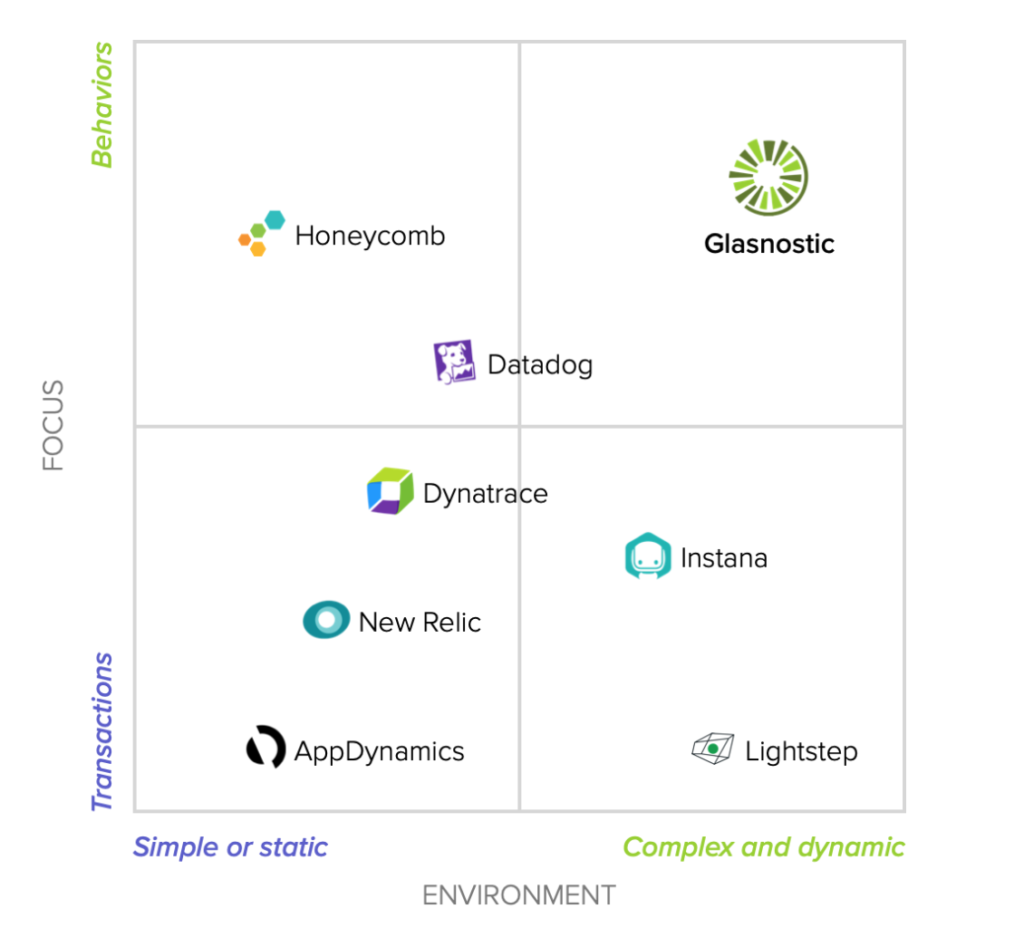
At a high level, the thing to remember is that of all the monitoring and observability solutions in the market, Glasnostic is the only solution that provides control. By focusing on control and management of the disruptive behaviors of today’s complex and dynamic environments, Glasnostic ensures optimum performance of these networks and minimizes cost and failures. Other vendors in the ecosystem include the public companies listed above along with startups such as, Honeycomb, Instana (just acquired by IBM), Pixie Labs (just acquired by New Relic), and Lightstep. Most of these vendors are analyzing the “transactions” between applications or microservices, while Glasnostic’s focus on the behaviors of the interactions provides much needed, and valuable, context. Glasnostic is purpose-built for the complex and dynamic environments of cloud native applications. Most competitors are best suited for legacy, simple, and static application environments.

The York IE team believes that it is beneficial to elaborate on the competitive dynamics between Glasnostic and the larger competitors in the market. It is important to understand that in the short term, there will be customers with monitoring needs Glasnostic can’t serve. For example, if a potential customer’s needs are 80% monitoring and 20% control, they will most likely choose Datadog or Splunk, or another incumbent to start. This is because that incumbent will provide them with a majority of what they need. Most companies though, will already have a lot of monitoring in their network, most likely from a variety of tools, so the monitoring slice will be much smaller. In these situations, Glasnostic’s opportunity will be determined based on their integrations with the monitoring solutions already in the network. By complementing existing tools, and providing control on top of the data and alerts they are sending to customers, Glasnostic will be able to penetrate their market and show its value. 
Since Glasnostic was founded in 2016, most of the team’s time and resources have been spent together with design partners developing the technology and platform. Now that the product is proven and production-ready, go-to-market is a primary focus. The core value prop that Glasnostic’s GTM strategy will be based on is that it simplifies and eases the operations half of DevOps. York IE believes this value prop should enable a bottom-up GTM motion that is driven from the love users have for the product and results in a community of “operators” that promote the product. A great example of this strategy is Datadog and how they scaled. Providing a great product that resulted in a community of adherents led to significant net new customer adoption as well as expansion within enterprises. This GTM model will leverage customer success, content marketing (drumbeat marketing, thought leadership, earned content, influencers in the market, etc), and inside sales to land and expand within operations and DevOps teams. Glasnostic also has the ability to be used for security purposes, providing for significant expansion potential within an enterprise beyond the Operations/DevOps team. However, as is the case with any early-stage startup, driving user adoption and fondness takes time. Working closely with initial customers will continue to be extremely important to ensure the product continues to mature in line with their needs and expectations. 
Although Glasnostic is well-positioned for a product-led GTM model, the leadership team has been able to drive some impressive early traction with Fortune 500 companies via top-down sales model, leveraging their network and pedigree in the market. Recently, Glasnostic landed a large European IT equipment and services provider as a customer. The company is also deeply engaged with multinational telecommunications corporations, government entities, and IoT consultancies. 
From a market channel perspective, Glasnostic launched in the AWS marketplace in November as a partner to the cloud provider. The company will look to leverage this relationship to help drive customer engagement and adoption. In Europe, Glasnostic is working with another innovative cloud provider as a channel partner.
The York IE team, having spent many years in the infrastructure and operations space, is truly blown away by the innovative platform developed by the Glasnostic team. We are extremely excited to partner with Tobias and his team, and are looking forward to helping Glasnostic achieve its awesome potential.

Market Pulse Portfolio Watchlist: Auditoria Named Best in Compliance 

In today’s Fuel Market Pulse we highlight Auditoria, from our York IE Portfolio watchlist. Recently, Auditoria was awarded “Best Compliance Solution 2020” by Tech Ascension Awards for their next-generation ERP innovation. Auditoria was one of just three FinTech companies honored this year and was praised for their “audit-ready” approach towards compliance with their SmartFlow platform.
To read the announcement for Auditoria’s award click the link here.

Leaders: Your Job is Context

There are so many jobs that are the responsibility of a strong leader; recruiting and hiring talent, setting organizational goals, measuring performance, motivation, building products, keeping customers happy, to name a few. That said, I have often felt that as a leader, your most important job is developing and sharing context with your team, and across the teams that you work with. The power of context is magical; as a founder, it is that context that sets your vision, mission, and values, but also your product roadmap, go to market plans, and passion for customers. Too often, the job of developing, managing, and sharing context is forgotten in rapidly growing organizations.

It goes something like this: A founding team joins forces together, perhaps a technology leader, a go-to market leader, and a business leader. A shared vision and mission are developed and translated to a product offering. Execution begins, and execution is relatively seamless because the context of the business is well understood by every player involved.

The team then grows; the founders recruit subject matter experts in the industry who are aligned with their vision and mission. Experts in engineering, sales, marketing, and business operations from competitors, other upstarts, or customers join allowing that context to remain intact across the teams being grown. Like earlier, execution remains relatively seamless, as goals, missions, and objectives (or rather, context) remains shared.

In my experience, this is when the context starts to breakdown unless founders and executives actively step up to counter the natural forces at play. One key factor is the nature of who can be recruited to the team changes. Assuredly, excellent engineers, go to market staff, and other professionals are brought onto the team, many of whom are likely have more experience in business, growth, and scale than earlier team members, and will help the business grow. However, something is missing; the context of the business isn’t there, this layer of new recruits hasn’t experienced the problem space firsthand, didn’t build the original product, or more likely, choose to work in their professional silos. Specialists in their job function, yet generalists in the core context of the business, don’t deeply understand the customer problem space, the solution set, and product/market fit.

In our days at Dyn, we felt this shift in the business around the 50-person mark. We could hire excellent software engineers, network operations staff, and support personnel, but not everyone joining were experts in the domain name system (DNS), and nor should we expect them to be. There’s a classic story of me handing Kyle York a technical book on the DNS, written by our good friend Cricket Liu. Did I expect Kyle to read the book cover to cover? I probably did. But that was not reasonable. However, it was packed with context that allowed Kyle to deeply understand our customer, our problem space, and our solution. He says he didn’t read it, but secretly, I think he did.

I recently had the honor to spend time with a founder who completely overhauled his business in light of COVID-19. Knowing the core business was at risk, this founder made a massive pivot, required him to invest much of the money the business had in its bank account and started anew to execute a revised business plan. The founder told me that it made some of his team members nervous (changing business plans and investing so much hard-earned money), but he knew it was going to work out. He asked the team to trust him, which they did, and it worked out. The difference between the founder and his staff: context. The founder had a plan, knew the pieces to assemble to make it work, and formulated a path to execute. The staff had a leader they trusted, but admittedly (stated by the founder himself), lacked the context of the plan, the pieces, and the execution path that the founder had in mind, creating uncertainty. With uncertainty, comes anxiety; of no use to us in a rapidly growing and changing organization.

How can we combat this as leaders? We have to make this our everyday job to work on and improve in our organizations. It can come through formal training efforts, brown bag lunch and learns (over Zoom, I suppose), all-hands meetings, and one on one conversations. It comes from knowing that not everyone in an organization can come in the door knowing all things about your business, but that everyone can learn something about the business every day, regardless of job function. We can combat that lack of context that creates uncertainty, anxiety, and disengagement by sharing, at all levels, every day.

As founders, CEOs, and even as managers, it is our job to define, share, and educate our teams about the context of our businesses. We are placed into positions of trust and power to absorb, interpret, and share context with our teams. When we take the time to develop and share our context, we empower others in our organization to understand our customers, products, and solutions. It allows the entire organization to align to common goals, missions, and values, as set and agreed upon by its leaders. Context is massive power.

York IE and NHTA Educate Next Generation of Sales Leaders with Exclusive Virtual Course 

10-week Course Provides Vital Knowledge for Professionals in B2B SaaS Sales Roles
(Manchester, NH, December 9, 2020) York IE, a vertically integrated investment firm, and the New Hampshire Tech Alliance (NHTA) announced today the first of a series of virtual courses to educate the New Hampshire community on key Business-to-Business (B2B) topics. SaaS Sales Leadership is a 10-week, virtual course that provides the tools for sales professionals to sharpen their skills in B2B Software-as-a-Service (SaaS) to excel in their current or future roles. 
In New Hampshire, there are many talented salespeople who have spent their careers selling various products. However, in the digital age, more and more traditional products and services are being delivered online. As a result, in the coming years, there will be a greater need than ever for high-quality salespeople who can sell SaaS to other businesses. There will also be a greater need for high-quality sales leaders who understand how to build, structure, and run a SaaS-based sales team.
“The majority of what you learn in sales can’t be taught in a normal classroom,” said Kyle York, CEO and co-founder of York IE. “As someone who has worked in and subsequently ran sales departments, the real-world experience is what’s needed to excel. This course provides that experience so the next generation of New Hampshire-based sales leadership can be prepped to hone and sharpen their revenue-generating skills.” 
Inside sales is a popular industry for young professionals, with average salaries starting at $60,000 not including commissions. An understanding of sales also provides key skills for career professionals across a variety of industries. This course, created by York IE in partnership with the NHTA, is giving sales professionals the opportunity to kickstart their career in B2B sales. 
The lessons, led by York and fellow York IE Managing Partner and co-founder, Adam Coughlin, are broken up into ten sections focusing on different areas or resources within sales, including culture, team structure, and more. Each of the ten virtual classes includes a 45-minute presentation and corresponding recording with supplemental coursework that provide participants with the opportunity to apply key learnings in real-world scenarios. The course will culminate with a virtual career fair that will allow course participants to meet with businesses that may potentially need B2B SaaS sales roles in early 2021. 
“Technology as a sector continues to steadily grow even in the midst of a pandemic. This program will allow individuals looking to transition into the sector an opportunity to turn transferable sales experience and other soft-skills into a technology sales career with a very healthy, livable wage. ” said Julie Demers, Executive Director, NHTA. “The unique approach that York IE and NHTA is taking will allow participants to learn directly from those in the B2B business. We are extremely excited about providing this top-notch course to NH residents.”
This is the second in a series of initiatives from York IE and the NHTA to support the NH tech community. The two recently teamed up to launch a new virtual community that brings NH-based technology executives and talent together from organizations across the globe. Learn more about the York IE and NHTA community here
Interested candidates can apply to join the SaaS Sales Leadership course here. The course is scheduled to begin in mid-January. 

ABOUT YORK IE

York IE is a vertically integrated investment firm powered by market data and analytics focused on growth, go-to-market, and strategy. Through its SaaS-based Fuel Platform, operating platform modules, and selective early-stage B2B SaaS investments, York IE supports ambitious entrepreneurs, operators and investors on their quest to scale startups and disrupt markets. Play the long game at York.IE.

ABOUT THE NEW HAMPSHIRE TECH ALLIANCE

Founded in 1983 as the New Hampshire High Tech Council, the Alliance is 300+ members strong, representing more than 60,000 workers. As a statewide technology association, the Alliance supports companies at every stage of growth and development – from startups to established leaders in the global economy. Its staff, Board, and 120+ volunteers nurture a vibrant tech ecosystem in New Hampshire through four value pillars: talent & workforce, education & programming, advocacy & policy, and ecosystem engagement. This sector is a key economic driver for the state, accounting for 13.7% of New Hampshire’s gross domestic product in 2018.  More information is available at www.nhtechalliance.org or by contacting its offices directly at (603) 935-8951 and info@NHTA.org.